Approach
The repository is organised as a reproducible pipeline in scripts/, numbered in run order:
01_data_audit → 02_build_pnl → 03_build_monthly_pnl → 04_monthly_performance
→ 05_expense_break → 06_payment_vs_pnl → 07_payment_categories → 08_payment_trends
→ 09_revenue_analysis → 10_monthly_revenue_by_unit → 11_profitability_analysis
→ 12_cost_analysis → 13_financial_controls → 14_management_action_plan
→ 15_ceo_executive_summary → 16_build_dashboard_data
Each step writes an Excel or CSV output to outputs/ (for example financial_controls_analysis.xlsx and management_action_plan.xlsx), and the final step builds the data layer used by the Power BI dashboard.
Key financial snapshot
| Metric | Result |
|---|---|
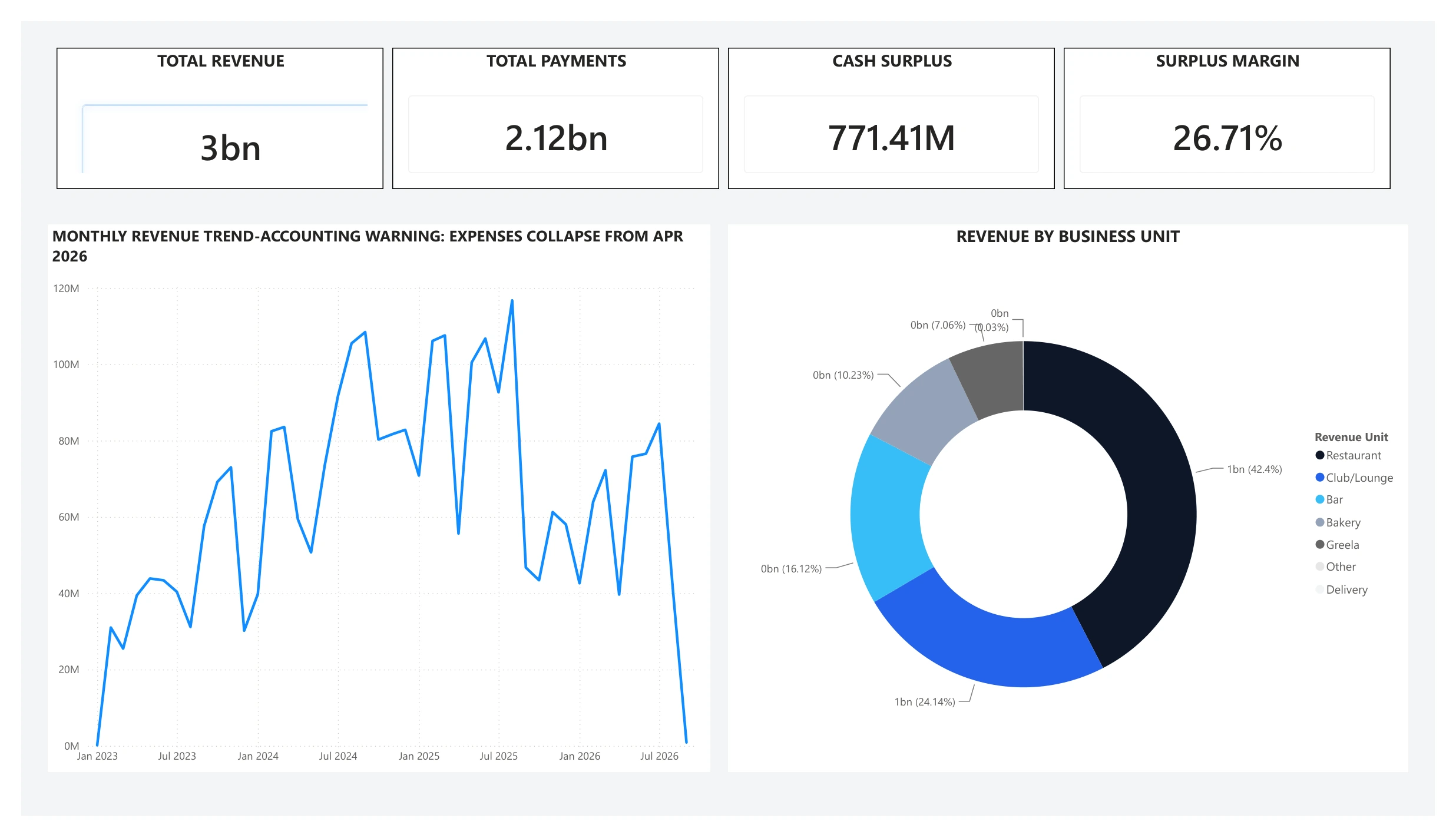
| Recorded sales | ₦2.888bn |
| Total receipts | ₦2.917bn |
| Total payments | ₦2.116bn |
| Reported bank/cash | ₦795.17m |
| Restaurant revenue share | ~42.4% |
| Restaurant + Club/Lounge | ~66.5% |
| Category | Approx. spend | Share |
|---|---|---|
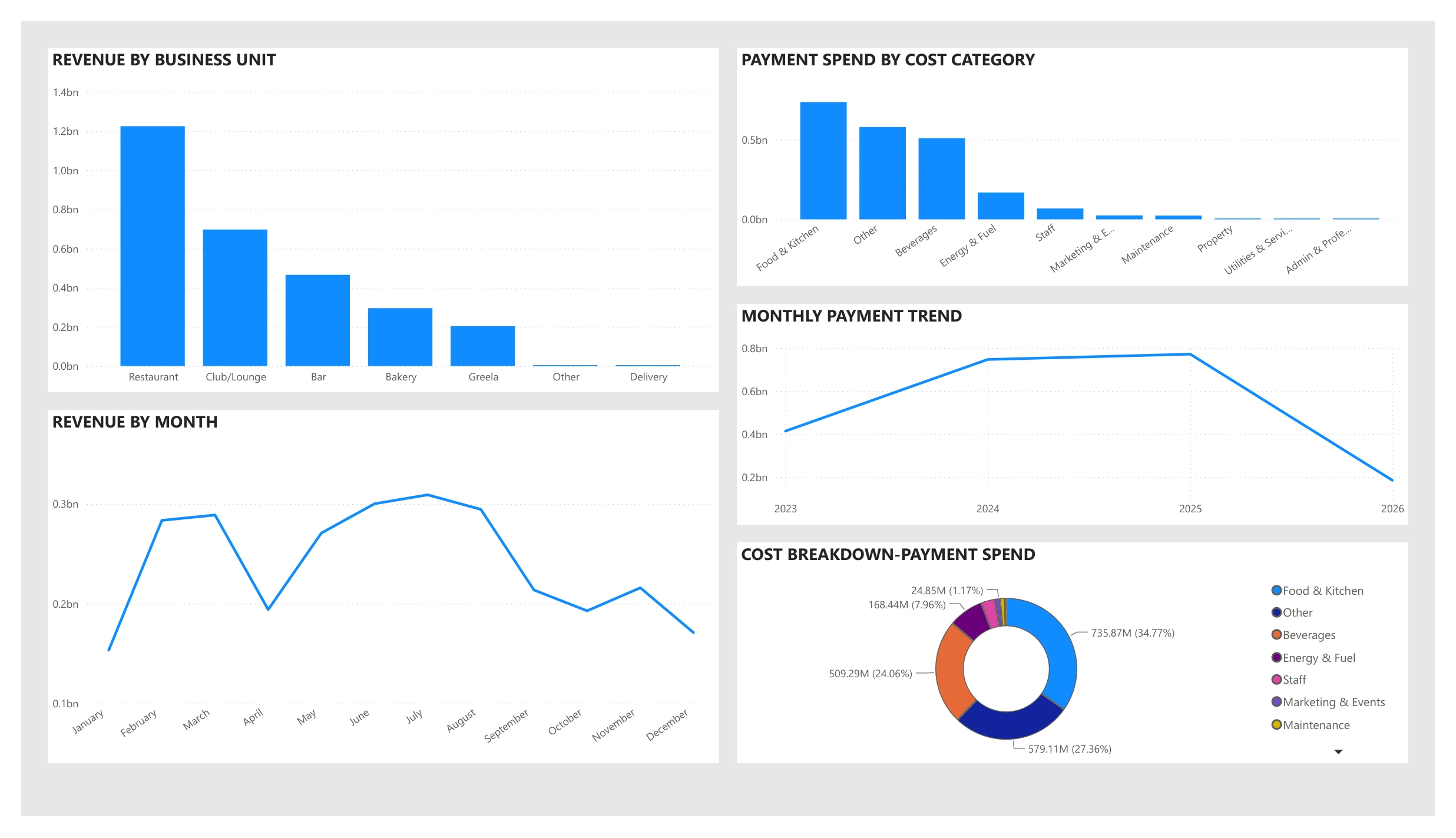
| Food & Kitchen | ₦735.6m | 34.8% |
| Beverages | ₦510.0m | 24.1% |
| Other / Unclassified | ₦556.3m | 26.3% |
Financial control findings
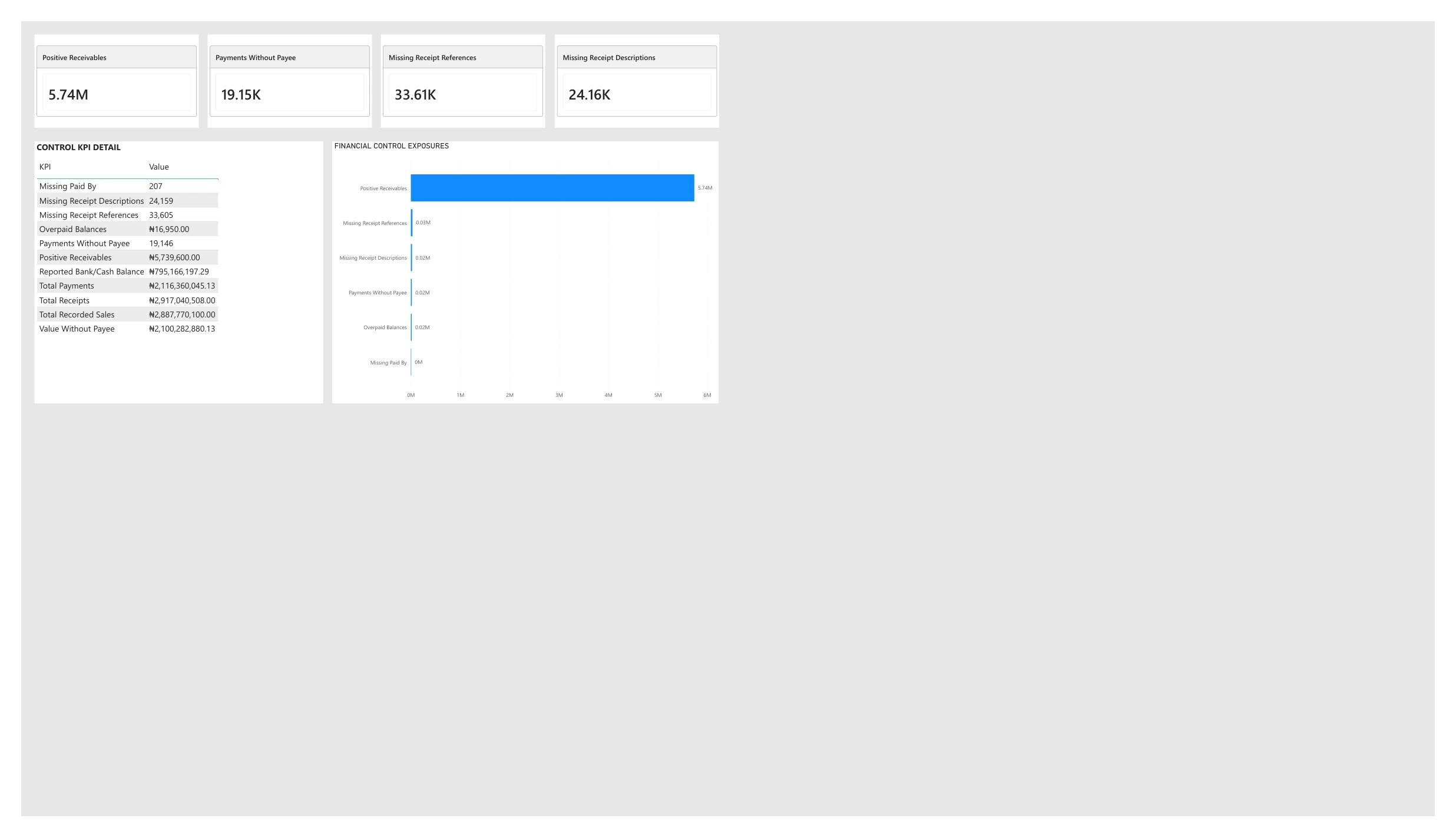
- 19,146 payments without a payee.
- 33,605 receipts without a reference, and 24,159 without a description.
- About ₦5.74m in positive receivables.
- A large “Other / Unclassified” payment category, which signals a classification weakness.
Control weaknesses are reported as exceptions for management review. They are not evidence of fraud, and the analysis does not claim they are.
The critical accounting issue
Recorded expenses collapse from April 2026 onward, from about ₦58.5m in March 2026 to about ₦2.1m in April and under ₦1m in each later month. That makes profit margins from April 2026 look unusually high. The recommendation was that reported profitability from that point should not be relied on until expense records are reconciled.
CEO action priorities
- Reconcile financial records from April 2026 onward.
- Restore complete and consistent expense recording.
- Make payee, receipt reference and transaction description mandatory where appropriate.
- Reclassify major “Other / Unclassified” payments.
- Introduce monthly bank reconciliation.
- Strengthen purchasing and stock controls around food and beverage spend.
Limits
- Control weaknesses (missing payees, references and descriptions) are reported as exceptions for review, not as evidence of fraud.
- Profitability from April 2026 onward is flagged as unreliable until expense records are reconciled, so no profit conclusion is drawn for that period.
- The business is not named, and this page does not publish source records.
What this project demonstrates
- Python data pipeline: 16 ordered pandas scripts from data audit to a dashboard data layer, each writing an inspectable output.
- Financial and control analysis: revenue mix, payment categories, profitability and data-quality checks.
- Power BI executive reporting: CEO Overview, Revenue & Cost and Financial Controls pages.
- Judgement: identifying when a headline number (profit) should not be trusted, and saying so.
From analysis to product
The same findings later shaped the mock data and screens of ControlDeck NG, a React proof of concept for an executive control dashboard.
Written by Emmanuel Abolade, Data Analyst, Business Intelligence Developer and Full-Stack Software Developer based in Hull, UK. Figures on this page are from the original analysis. Source records are not published. The analysis approach and dashboard evidence are shown above.