Problem
A local congregation needed one place for visitors to find service information and plan a first visit, and a private side where members and the church team could manage services, presence and what appears on the projector during a service, without juggling separate tools.
Solution
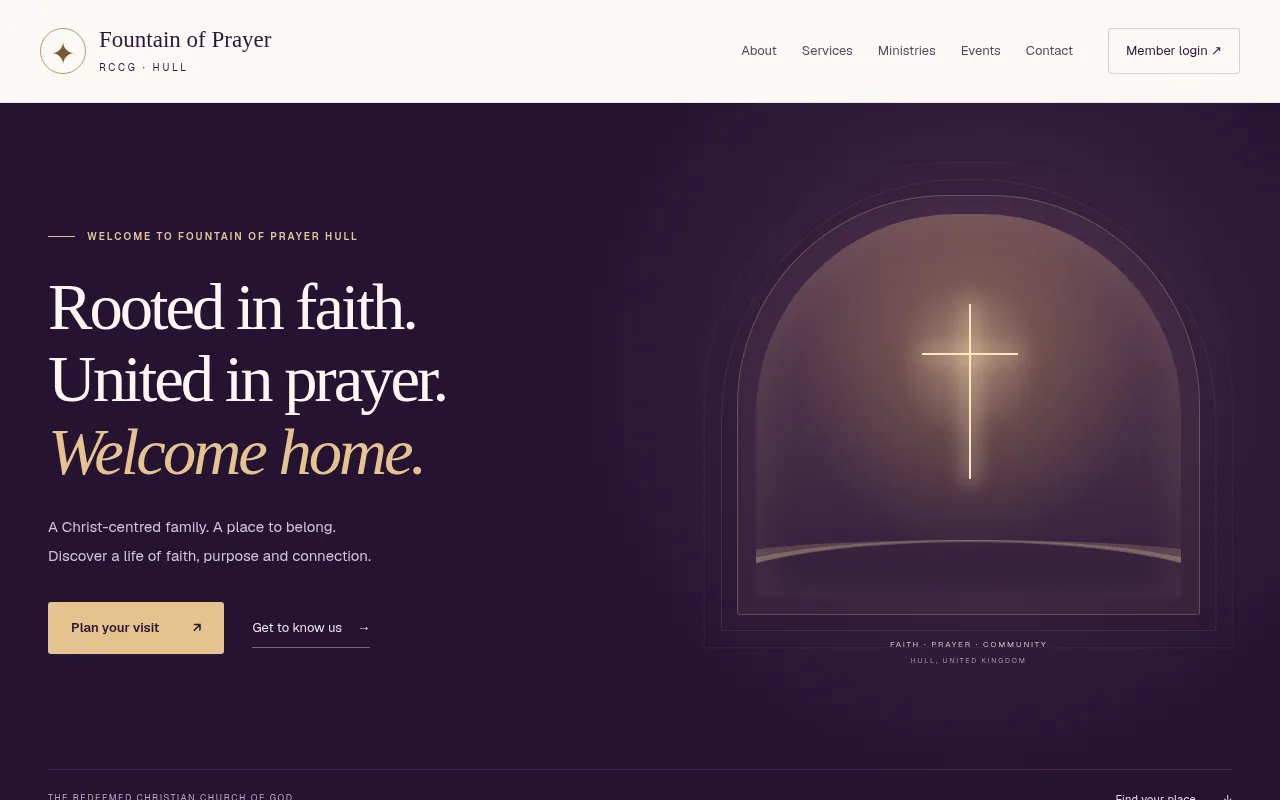
- Public website: Home, About, Services, Ministries, Events, Contact, Plan Your Visit and a visitor check-in form, with a skip link, responsive navigation, focus styles and reduced-motion support. Unconfirmed details use clear “coming soon” wording rather than invented content.
- Member area: sign-in by magic link or password, password recovery, and a dashboard showing the member’s own presence for today’s live service.
- Staff areas: pastor service management and an admin area for managing roles, with protections around membership role changes.
- Media dashboard and display: verse and lyrics presentation, announcements and presentation-safe content, a live preview, and a full-screen display page that updates in real time.
Architecture
Browser ─▶ Next.js App Router (server components, server actions)
            │   Proxy: refreshes the session, protects signed-in routes
            ▼
        Supabase Auth (PKCE)  ─  Postgres with row-level security
            │                         ▲
   Media dashboard ── writes presentation state
            │                         │
   Display page  ◀── Supabase Realtime (postgres_changes subscription)
Roles are read from the database membership record, never from user-editable metadata, and each signed-in area has its own server-side session guard. Data access goes through the standard client so row-level security applies to every query.
Technologies
Next.js 16 App Router, React 19, TypeScript, Tailwind CSS 4 and CSS Modules for the public pages, @supabase/ssr for cookie-based sessions, Supabase Postgres migrations, Supabase Realtime, Node’s built-in test runner and ESLint, deployed on Vercel.
Implementation highlights
- Session handling: PKCE magic-link callback, refresh-cookie propagation through the proxy, and sign-out that invalidates cached layouts.
- Time zones: “today’s live service” is calculated in the Europe/London time zone so presence does not drift around midnight or clock changes.
- Realtime presentation: the display subscribes to a per-location presentation state, so the media team can put a verse or lyric on screen from another device.
- Delivery: 32 commits and two merged pull requests between 8 and 13 October 2026.
Demonstration
The public pages can be visited on the live site. Member, staff and media areas require an account issued by the church team, so they are described here rather than shown.
Results
- Public site deployed on Vercel (pages returned HTTP 200 when checked on 12 November 2026).
- 33 automated tests covering the auth callback, redirect guards, protected routing, sign-out, roles, data scoping, time-zone handling and error states passed on a local run on 12 November 2026.
- No usage or attendance figures are claimed.
Limitations
- The automated tests use provider doubles; they do not prove real email delivery or row-level security end to end, which the project documentation records as needing live checks with authorised accounts.
- Several public details (for example ministry groups and event listings) await confirmation from the church and are marked as coming soon.
What this project demonstrates
- Full-stack TypeScript: server components, server actions and a typed data layer.
- Authentication and authorisation: role-based areas backed by database roles and row-level security.
- Realtime features: live presentation control across devices.
- Accessible public design: semantic pages, keyboard navigation and reduced-motion support.
Written by Emmanuel Abolade, Data Analyst, Business Intelligence Developer and Full-Stack Software Developer based in Hull, UK. Only the public website is linked. No member, attendance or internal information is shown on this page.